
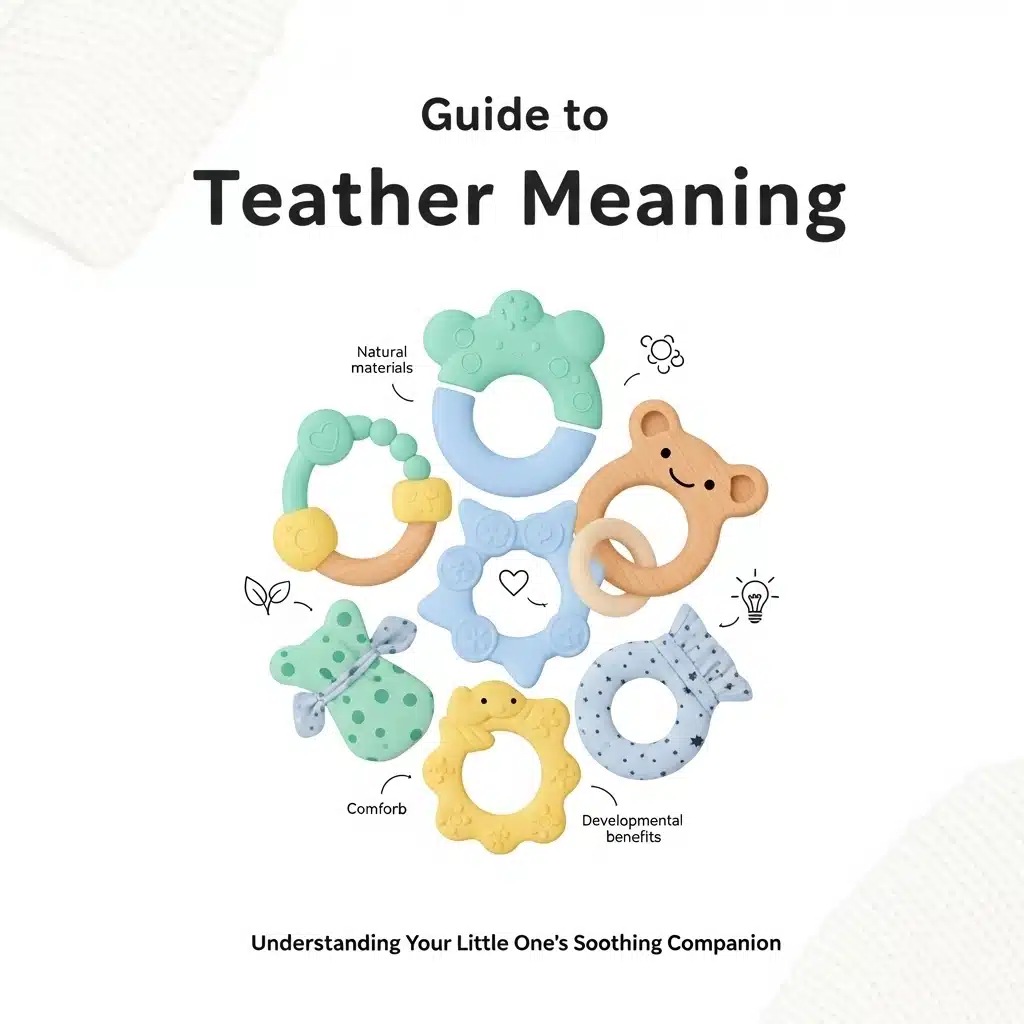
If you are currently surviving the Teething Wars, you know the sound: that high-pitched, desperate whine that cuts right to your soul. It’s the sound of tiny, perfect teeth trying to violently escape their gums.
In my desperation, I went to the store and bought everything. I bought wooden rings, silicone loops, fuzzy things, vibrating things, and things shaped like small animals. I spent a fortune. My son, however, preferred to chew on the remote control, the edge of a book, or, one memorable time, my house keys.
The “So What?”: Why did I waste so much money? Because I didn’t understand the teether meaning, the underlying purpose of the different types. I thought “a teether is a teether.” Wrong. A baby needs a screwdriver for one job and a hammer for another. You need to match the tool to the specific pain.
Thesis: I learned that effective teething relief comes down to matching the baby’s specific symptom (itch, swelling, or deep ache) to the right type of teether. This guide breaks down the four main categories so you can stop guessing and start soothing.
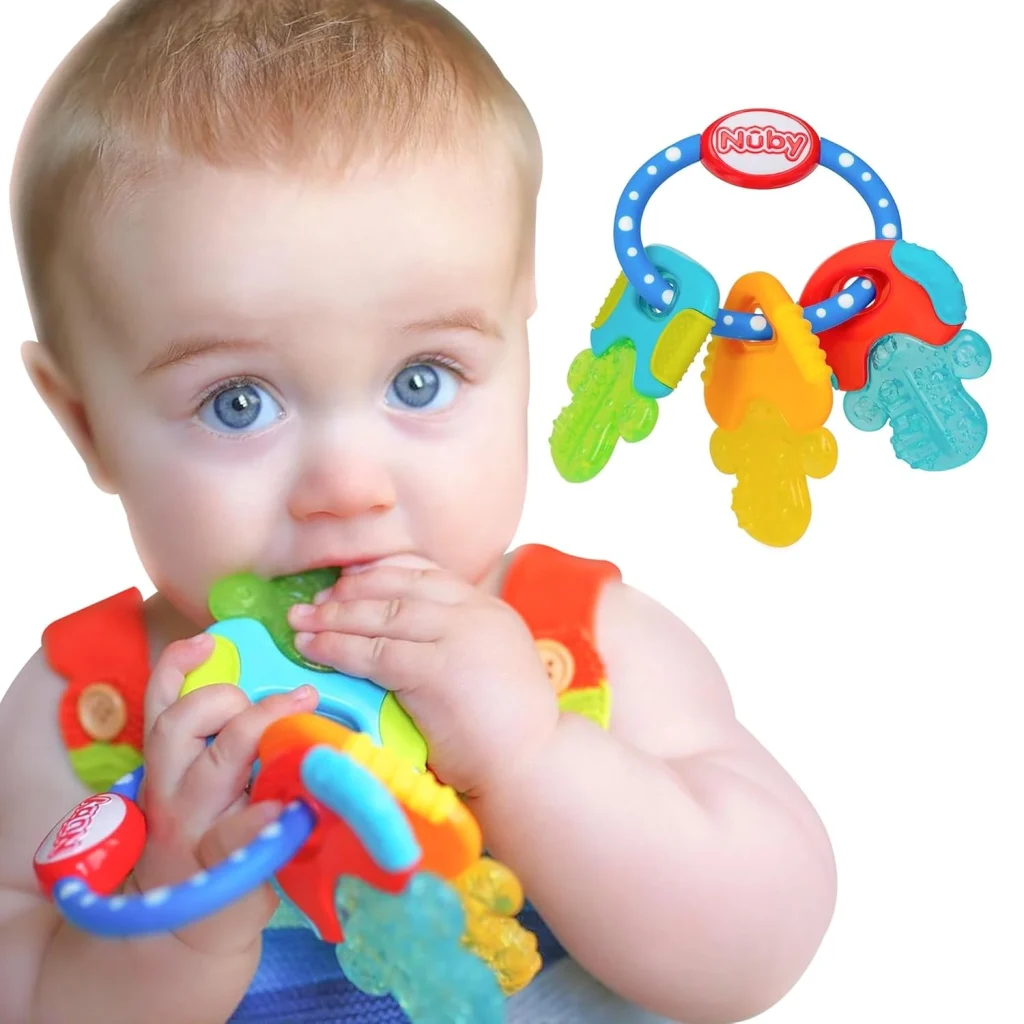
The Big Lie: All Teethers Are NOT Created Equal
- Your Baby’s Pain Changes, Your Tool Should Too.
The biggest misconception I had was that teething was a static problem. “Oh, he’s teething today.” The truth is, the pain evolves.
- Phase 1: The Itch. Before the tooth moves, the gums feel tight and itchy. This requires friction and texture.
- Phase 2: The Swell. The gum is red, swollen, and hot. This requires cold and compression.
- Phase 3: The Eruption. The tooth is cutting through. This requires targeted, hard pressure.
I initially only bought soft, squishy teethers (Phase 1). When Phase 2 hit, those teethers did absolutely nothing, and I panicked, thinking I needed a new toy.
The “Aha!” Moment
My sanity returned the day I realized my son needed two different items on the tray: a soft, textured wand for the drooly, itchy days and a hard, cold ring for the swollen, red days. I stopped treating the problem with one generic solution and started treating the symptoms.
My 3-Step Teething Type Match Framework
Once you understand the teether meaning, the buying process gets much easier. Here’s how I assess the situation now:
Step 1: The Gum Check (Assessing the Need)
I physically run my (clean!) finger over their gums.
- Smooth and wet? They need an Itch-Scratcher (texture).
- Hot, red, and bulbous? They need a Cooling Calmer (cold).
- Wailing and batting at their ear? They need a Back-Molar Buster (deep reach).
Step 2: The Grip Test (Motility)
If the teether is too large, too small, or too floppy, the baby can’t get it where it hurts. The best teethers have a thin stem and a large handle.
- A Surprising Win: I found that teethers shaped like a banana or a long-handled toothbrush were absolute gold because they could reach the deep, painful molars that a simple ring couldn’t touch. They actually targeted the pain!
Step 3: The Sanity/Safety Test (Durability)
If a teether is porous or has tiny crevices, it’s a breeding ground for germs.
- A Personal Mistake: I bought a cute plastic teether that was water-filled and had tiny seams. It cracked after one tumble, leaking questionable liquid, and it was impossible to truly sterilize. I learned to stick to single-piece, seamless silicone.
A Real-World Case Study: The Midnight Molars
The Before:
My son was 10 months old, and his first molars were making their debut. He woke up screaming every hour on the hour. I felt guilty about giving him infant acetaminophen every night, but nothing else worked. We were both shells of humans.
The Process:
I started the Gum Check (Step 1). His back gums were visibly red and swollen. I realized the problem wasn’t the front itch; it was deep pressure. I ditched the cute, soft ring and started rotating two specific tools: a long, solid silicone stick and a flat stainless steel cooling teether (used only for short bursts).
The After:
The first night I gave him the targeted cooling stick, he calmed down in seconds. He was able to apply firm, cold pressure directly to the source of the pain. We reduced his reliance on medicine, and he was able to sleep in 3-4 hour chunks again. It taught me that sometimes, the simple, hard tools are the most effective.
Teether Meaning Decoded: Match the Symptom to the Tool
Understanding the four core functions, the real teether meaning is the key to finding relief.
| Teether Type | Primary Need | Key Feature | My Favorite Examples |
| 1. The Itch-Scratcher | Surface itchiness, drooling | Soft, textured bumps and ridges. Easy for a palmar grip. | Silicone mitts, textured pacifiers, soft fruit feeders. |
| 2. The Cooling Calmer | Swollen, inflamed, acute pain | Must be freezable. Firm but yielding when cold. | Solid stainless steel rings, silicone ring with a thick middle, large cloth ice packs. |
| 3. The Back-Molar Buster | Deep pain, far-back tooth eruption | Long, curved shape, or a clear handle to reach the back of the mouth. | Banana-shaped brushes, long wands with a stopper. |
| 4. The Oral Motor Explorer | Sensory input, texture practice, low pain days | Soft, pliable, sometimes hollow, multiple textures (for gum strengthening). | Crinkle toys (supervise!), food-grade wood rings, hollow silicone feeders. |
CONCLUSION
Next time you see a cute, expensive teether, pause. Take a moment to understand the teether meaning behind its design. Is it built for pressure, friction, or cold? Then, check your baby’s mouth.
You don’t need to buy ten different teethers. You just need one reliable option from each of the four functional categories. Choose wisely, trust your gut, and remember: this too shall pass.
I’d love to know what weird, non-teether item did your baby prefer to chew on? (Tell me I’m not the only one whose kid liked the remote control best!)
Leave a Reply