
We spend months picking the perfect name. We spend weeks debating the “aesthetic” of the nursery wallpaper. We spend hours researching the safest car seats. But for many of us, the most daunting part of the journey is the one we talk about the least: the first year baby expenses.
In 2026, the cost of raising a child has become a moving target. With the “subscription economy” hitting everything from smart-diaper sensors to organic meal kits, it is incredibly easy to let your spending spiral. You start with a simple pacifier and end up with a high-tech cradle that costs more than a week in Ibiza.
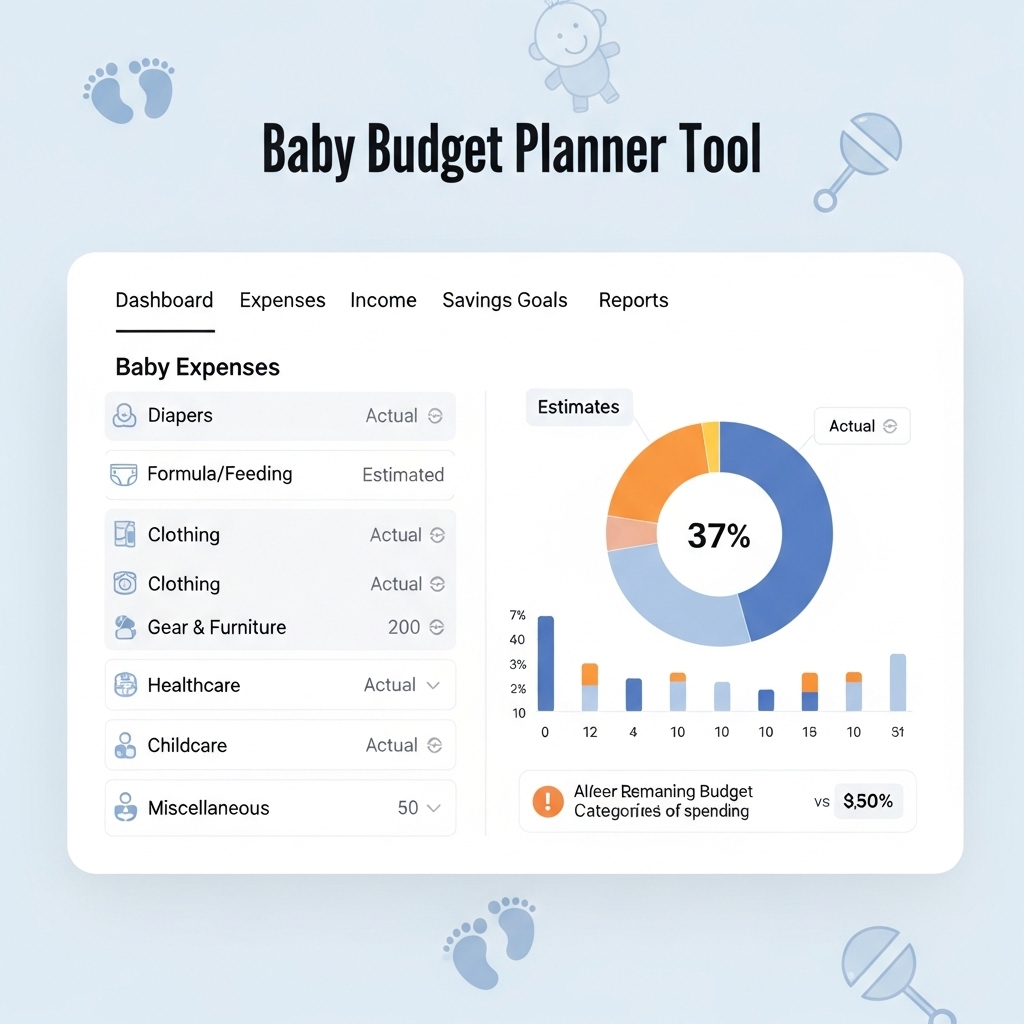
To help you keep your feet on the ground, we’ve integrated the Baby Budget Planner Tool below. It’s designed to turn that vague “babies are expensive” fear into a concrete, manageable monthly number.

Why 2026 is Different: The New Economics of Parenting
If you ask your parents what they spent on you, their answer won’t help you much. The 2026 landscape for first year baby expenses has been reshaped by three major factors:
- The Tech Premium: We now have AI-monitors that track breathing and “smart” bottles that track intake. While helpful, these add hundreds to the initial setup cost.
- Specialization: From hypoallergenic bamboo diapers to goat-milk-based formulas, the “standard” options are being replaced by “premium” niches.
- Inflation Fluctuations: Basics like wipes and laundry detergent have seen price shifts that make “bulk buying” a strategic necessity rather than a suggestion.
Using a budget tool isn’t about being “cheap,” it’s about being strategic. Every dollar you save on a brand-name onesie (that will be covered in spit-up anyway) is a dollar you can put into your child’s long-term education fund.
The Monthly Breakdown: Where Does the Money Go?
Our Baby Budget Planner tracks the six vital categories that define your monthly outgoings. Here is how to think about each one in the current market:
1. The Diaper Dividend
In your first year, you will change approximately 2,500 to 3,000 diapers. In 2026, many parents are finding that the “middle-tier” eco-friendly brands offer the best balance of skin safety and price.
- Pro-Tip: Calculate your “cost per diaper,” not “cost per pack.” A ₦15,000 pack might look cheap until you realize it has 20 fewer diapers than the ₦18,000 pack.
2. The Formula & Food Factor
Whether you are using formula or transitioning to solids at 6 months, this is your most “locked-in” cost.
- The Math: If your baby consumes 800ml of formula a day, and a 400g tin makes roughly 2.8 Litres, you are looking at one tin every 3.5 days. That’s roughly 8 to 9 tins a month.
3. Clothes & Rapid Growth
Babies don’t just grow; they “evolve.” A “Newborn” size might only fit for three weeks. Your first year baby expenses in this category should focus on “multi-packs” and stretchable fabrics.
4. Healthcare: The Silent Variable
Checkups, vitamins, and the inevitable “first fever” pharmacy run. Even if you have great insurance, the out-of-pocket costs for specialty creams or probiotic drops add up.
5. Toys & Mental Development
In 2026, “Sensory Play” is the big trend. However, your baby’s brain develops just as well with a $5 set of stacking cups as it does with a $150 “Subscription Toy Box.” Use the tool to set a limit on “impulse toy buys.”
6. The “Everything Else” (Miscellaneous)
Batteries for the monitor, extra-strength laundry pods, diaper disposal bags, and the occasional “I’m too tired to cook” takeout for the parents.
Using the “Monthly Burn Rate” Formula
To get the most out of our tool, you should understand the basic formula for your total monthly commitment ($T$):
$$T = (D + F + C + H + L + M)$$
Where:
- $D$ = Diapers & Wipes
- $F$ = Food/Formula
- $C$ = Clothing/Gear
- $H$ = Healthcare
- $L$ = Learning/Toys
- $M$ = Miscellaneous
By plugging your specific local prices into the Baby Budget Planner, you can see if your $T$ is sustainable. If your total exceeds $30\%$ of your household’s disposable income, it’s time to look at the “Wildcard Hacks” below.
2026 Money Hacks: Slashing Your First Year Costs
If the calculator shows a number that makes your eyes water, don’t panic. Here is how the “Smart Parents” of 2026 are beating the system:
- The “Hand-Me-Down” Economy: Facebook Marketplace and local “Parent Swap” groups are goldmines. Most baby clothes are worn less than five times before being outgrown.
- Generic is Great: For items like cotton balls, saline drops, and basic wipes, the store brand is often identical to the premium brand.
- The “registry” Pivot: Instead of asking for cute outfits at your baby shower, ask for “Nappy Fund” contributions or vouchers for healthcare.
- DIY Purees: Once your baby hits 6 months, buying a bag of carrots and steaming them costs $90\%$ less than buying pre-made organic jars.
- Energy Audit: Babies mean the washing machine is always running. Use cold-water cycles and “eco-modes” to prevent your utility bill from becoming your seventh expense category.
FAQ: Your Questions on First Year Baby Expenses
1. What is the most “unexpected” cost in the first year?
Usually, it’s the Miscellaneous category, specifically laundry and cleaning. You will find yourself washing clothes, bedding, and towels three times more often than before.
2. Should I buy a high-tech smart monitor?
In 2026, these are popular, but they aren’t a necessity for a healthy baby. If it stretches your budget too thin, a standard audio/video monitor is more than enough for safety.
3. How much should I budget for “Emergency” healthcare?
We recommend keeping at least three times your monthly healthcare entry in a separate savings “bucket” for those midnight ER visits or specialist consultations.
4. Is it cheaper to buy in bulk?
Usually, yes, but only if you know your baby won’t have a reaction. Don’t buy 500 diapers of a new brand until you’ve tested a small pack first!
5. Does the budget change as the baby gets older?
Yes. Diaper costs go down slightly as they get older, but food costs often go up as they start eating solids and requiring more varied nutrients.
Conclusion: Preparation is the Best Parenting Tool
The first year of your child’s life is a whirlwind of emotions, milestones, and yes, receipts. But financial stress shouldn’t be the thing you remember most about this time.
By using the Baby Budget Planner Tool to map out your first year baby expenses, you are giving yourself the gift of “mental margin.” When you know the numbers are handled, you can stop worrying about the price of the formula and start enjoying the way your baby looks at you when they’re drinking it.
Take the first step toward a stress-free 2026. Fill out the fields in the planner above and see exactly where you stand. Whether you’re a “Minimalist” or a “Premium” parent, being informed is the first step to being a great provider.
Leave a Reply