
If there is one thing that unites every parent on the planet, it is the obsessive tracking of ounces and milliliters. We stare at that little plastic bottle like it’s a high-stakes stock ticker. If they drink it all, we worry they’re still hungry. If they leave ten milliliters at the bottom, we worry they’re fading away.
In 2026, we have more data than ever. We have “smart nipples” that track flow rates and apps that sync to our refrigerators. But all that tech can actually increase the “Feeding Fog,” that state of confusion where you don’t know if your baby is crying because they’re hungry, tired, or just bored of the ceiling fan.
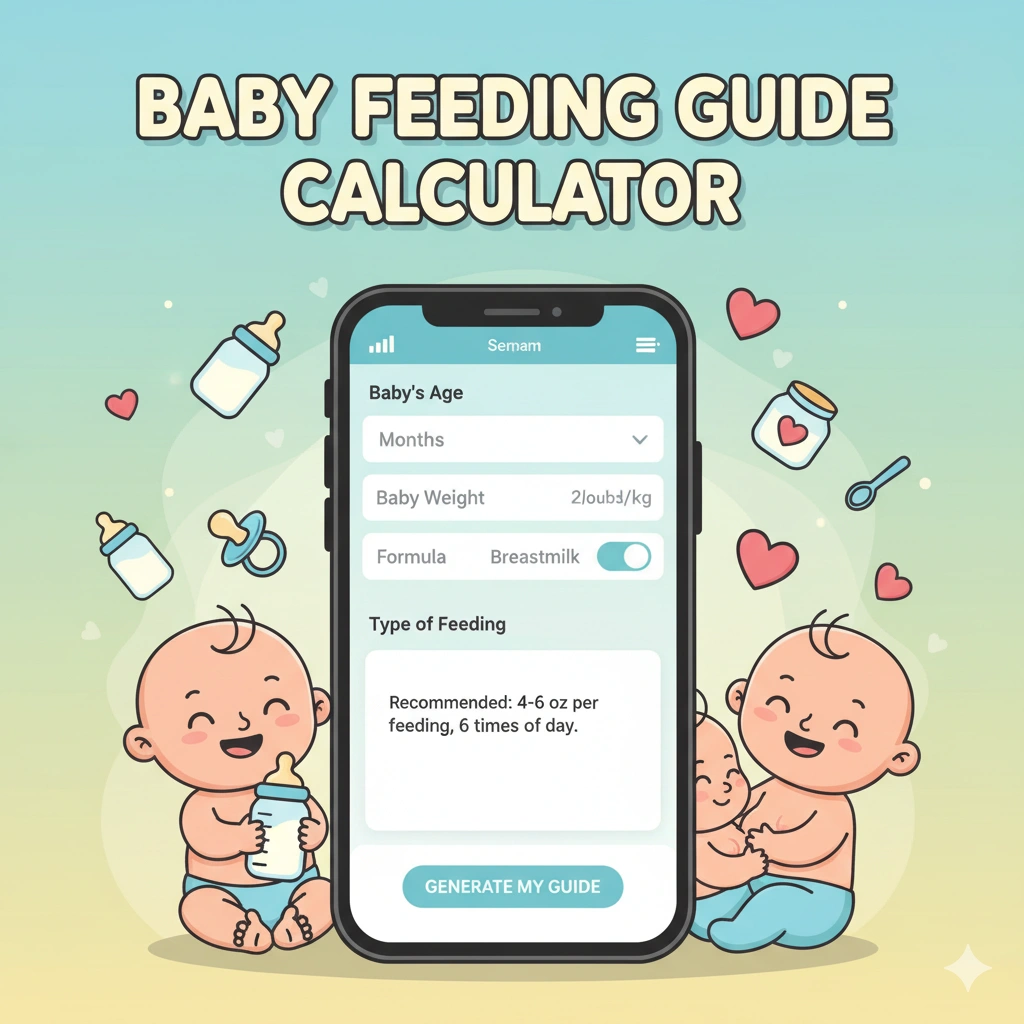
To help you clear the fog, we’ve developed the Baby Feeding Guide Calculator. It’s a tool designed to provide a science-backed baseline so you can stop guessing and start trusting the process.
The “Milky Math” Formula: How the Calculator Works
While every baby is a unique little human with their own appetite, pediatricians generally follow a specific biological formula for the first six months of life. Most healthy infants require between 150 ml and 200 ml of milk or formula per kilogram of body weight every 24 hours.
If you want to check the math manually, the formula looks like this:
$$Minimum\ Daily\ Intake = \text{Weight (kg)} \times 150$$
$$Maximum\ Daily\ Intake = \text{Weight (kg)} \times 200$$
Our baby feeding chart tool does this heavy lifting for you instantly. By entering your baby’s current weight and age, you get a “safe zone.” As long as your baby is landing somewhere between that minimum and maximum over a 24-hour period, you can take a deep breath, they are getting exactly what they need to thrive.
Age vs. Appetite: The 2026 Development Roadmap
As your baby grows, their stomach capacity increases, but their frequency of feeding usually decreases. Here is how the 2026 feeding landscape typically breaks down:
1. The “Bottomless Pit” Phase (0–2 Months)
Your baby’s stomach is roughly the size of a cherry at birth, growing to the size of an egg by one month. Because their stomach is small, they need to eat often.
- Frequency: 8–12 times per day.
- The Reality: In 2026, we’ve moved away from strict “scheduled” feedings. If the baby is hungry at the 1.5-hour mark, feed them. This “on-demand” approach is the gold standard for healthy weight gain.
2. The “Social Feeder” Phase (2–6 Months)
This is the golden age of feeding. They are becoming more efficient at the breast or bottle. They can take in more milk at once, meaning you might finally get a 4-hour stretch of sleep (maybe).
- Frequency: 6–8 times per day.
- The Reality: This is when “distracted feeding” starts. Your baby will pull away from the bottle because they heard a bird outside or saw the dog walk by. Don’t force the finish; if they’re done, they’re done.
3. The “Solid Shift” (6–12 Months)
The introduction of solids (around 6 months) changes the baby feeding chart math. Milk remains the primary source of nutrition, but as they eat more mashed sweet potatoes and avocado, their milk volume will naturally start to dip toward the lower end of the calculator’s range.
- Frequency: 4–6 times per day.
Cues are King: Why the Calculator is Just a Guide
Even the most accurate infant milk intake calculator cannot account for a “growth spurt” Tuesday or a “teething” Friday. In 2026, pediatric experts emphasize Responsive Feeding. This means using the calculator to know what’s “normal,” but using the baby to know what’s “now.”
Early Hunger Cues (The “Feed Me” Signals):
- Rooting: Turning their head and opening their mouth when their cheek is touched.
- Sucking on Hands: If they are frantically gnawing on their knuckles, the kitchen is open.
- Smacking Lips: A classic sign that they are dreaming of their next bottle.
Late Hunger Cues (The “You’re Late” Signals):
- Crying: This is actually the last sign of hunger. If they are screaming, they are likely frustrated. You may need to calm them down with a cuddle before they will latch or take a bottle properly.
Common 2026 Feeding Hurdles (And How to Jump Them)
The “Overfeeding” Myth
Many parents worry they are overfeeding their baby, especially with a bottle. However, babies are remarkably good at self-regulating. If your baby is turning their head away, pushing the bottle with their tongue, or falling into a “milk coma” (deep, relaxed sleep), they are finished. Never force a baby to “finish the bottle” just to hit the number on the chart.
Spit-Up vs. Vomit
In the first year, “Spit-Up” is a laundry problem, not a medical one. If your baby is happy, gaining weight, and producing 6–8 wet diapers a day, a little spit-up is just their immature digestive system working things out. If the spit-up is projectile, green, or causing pain, that’s when you call the doctor.
The Water Question
A common question in 2026: “Does my baby need water in the summer?”
The Answer: No. For babies under 6 months, breastmilk and formula are roughly 80% water. Giving them extra water can actually fill up their tiny stomachs and prevent them from getting the calories they need. Stick to the baby feeding chart volumes for hydration.
Frequently Asked Questions (FAQ)
1. My baby wants more than the “Maximum” on the calculator. Is that okay?
Yes! Growth spurts (usually around 3 weeks, 6 weeks, 3 months, and 6 months) turn babies into bottomless pits for 24–48 hours. Follow their lead. The calculator is an average, and some days will be above average.
2. Can I use this for breastmilk and formula?
Absolutely. The volume requirements for a baby’s stomach are the same regardless of what is in the bottle.
3. What if my baby is sleepy and hasn’t eaten in 4 hours?
For the first few weeks, you may need to wake a sleepy baby to ensure they hit their minimum calories. Once they have cleared their “birth weight” and your pediatrician gives the okay, you can generally let them sleep and feed them when they wake up.
4. How do I know if they are getting enough?
Ignore the ounces for a second and look at the diapers. You want to see 6 or more heavy wet diapers in a 24-hour period. That is the ultimate proof that the “input” matches the “output.”
5. Why does the frequency decrease as they get older?
As the baby’s stomach grows, they can hold more at once. Think of it like a fuel tank: a small tank needs constant refills; a larger tank can go much further between stops.
Conclusion: Trust Your Baby, Use the Tool
The journey of feeding your baby is one of the most intimate and intense parts of the first year. It’s a dance between science (the numbers on the Baby Feeding Guide Calculator) and soul (the bond between you and your child).
Use our tool to give yourself a sense of security. If you see that your baby is within the 150–200 ml/kg range, give yourself permission to stop worrying. You are doing a great job.
Ready to see your baby’s magic number? Scroll back up to the calculator, enter their latest weight from the doctor’s office, and get your customized feeding guide today.
Leave a Reply