
In the quiet hours of 4:00 AM, the world feels very small. It’s just you, a wide-awake infant, and the glowing screen of your phone as you search for “how to make a baby sleep.”
In 2026, sleep isn’t just a luxury; it’s treated as a pillar of mental health for the entire family. We’ve traded the old-school, rigid “schedules” for something much smarter: Biological Rhythms. Instead of forcing a baby to sleep because the clock says it’s 10:00 AM, we look at their internal “Sleep Pressure.”
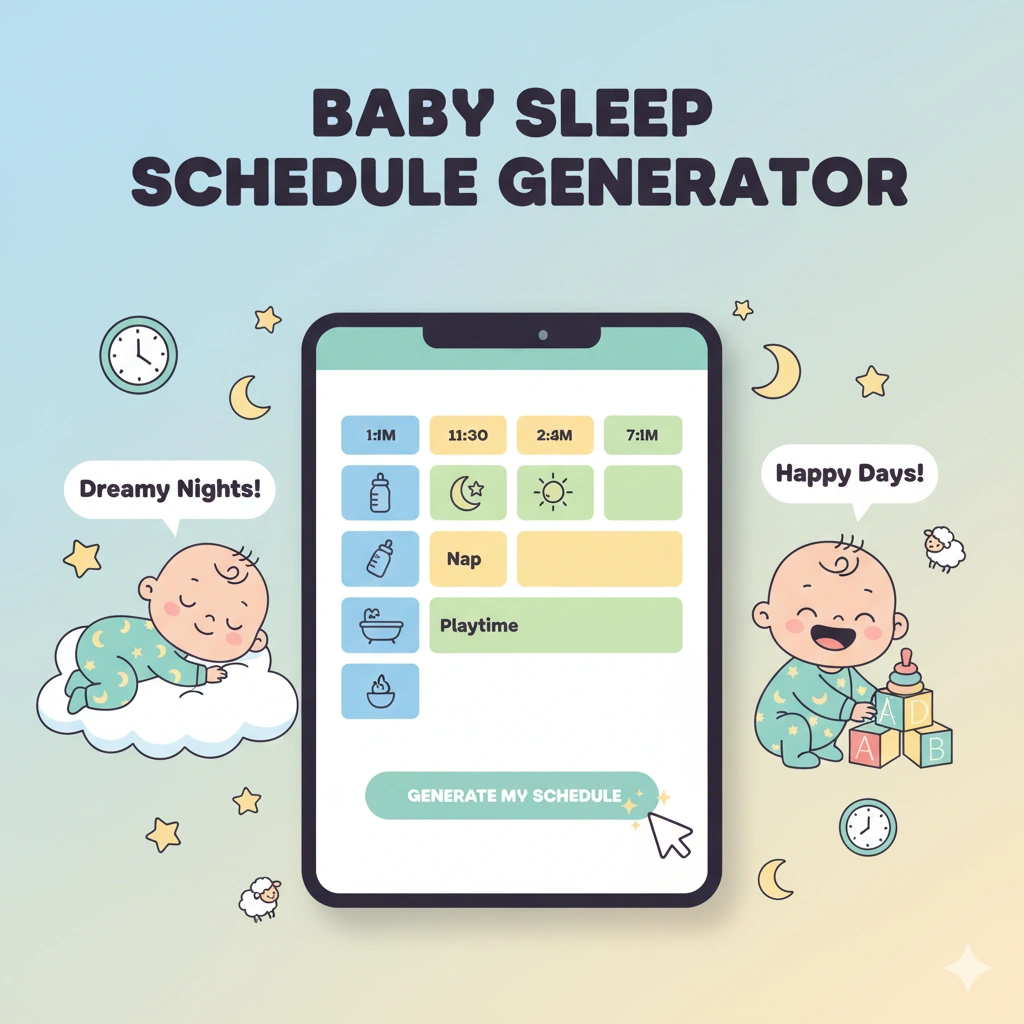
To help you map out this invisible pressure, we’ve built the Baby Sleep Schedule Generator below. It uses age-calibrated wake windows to suggest a day that balances rest and play.

The Physics of Sleep: Understanding “Wake Windows”
The secret sauce of a successful baby sleep schedule in 2026 is the Wake Window. This is the specific amount of time a baby can stay awake before their brain becomes “overtired” and flooded with cortisol (the stress hormone), making it twice as hard for them to settle down.
We can think of sleep pressure ($P_s$) as a function of the time spent awake ($t_w$):
$$P_s \propto t_w$$
As $t_w$ increases, the biological drive to sleep builds. However, if $t_w$ exceeds the “Optimal Window,” the baby enters a state of “over-arousal,” which looks like a sudden burst of energy or a frantic “second wind.” Our generator does the math to ensure you hit the “Sweet Spot” before that cortisol spike happens.
The 2026 Sleep Roadmap by Age
Our Baby Sleep Schedule Generator adjusts its logic based on these developmental milestones:
0–4 Months: The “Fourth Trimester” Chaos
At this stage, the circadian rhythm (the internal clock that tells us day from night) is still under construction.
- Focus: Gentle exposure to daylight and keeping wake windows very short (often just 45–90 minutes).
- 2026 Trend: “Contact Naps” are celebrated. Holding your baby for sleep isn’t a “bad habit,” it’s biological co-regulation.
5–9 Months: The “Three-to-Two” Transition
This is the golden age of the baby sleep schedule. Your baby is likely moving from three naps down to two.
- The Goal: A solid morning nap and a long afternoon nap.
- The Challenge: Developmental leaps (like crawling) can temporarily “break” the schedule as the brain practices new skills in its sleep.
10–18 Months: The One-Nap Milestone
Most toddlers transition to a single, midday nap during this window. This is the most stable your schedule will feel for a long time.
- Bedtime Strategy: As the nap gets longer, bedtime often needs to shift slightly later to ensure enough “Sleep Pressure” has built up.
2026 Sleep Essentials: The “Sleep Hygiene” Checklist
Beyond the timing, the environment plays a massive role in whether the schedule “sticks.”
- The Red Light Shift: In 2026, we’ve ditched blue-light-emitting monitors and nightlights. Using warm red or amber light in the hour before bed helps the body produce melatonin.
- Sound Landscapes: Simple white noise is being replaced by “Pink Noise” (which sounds like rain) or “Brown Noise” (which sounds like a deep rumble), which studies suggest may be more effective for deep sleep.
- Temperature Control: The “Smart Nursery” of 2026 maintains a consistent 18–20°C (64–68°F). A slightly cool room is scientifically proven to lead to better sleep cycles.
Troubleshooting: Why the Schedule Fails (And How to Fix It)
Even with the best baby sleep schedule, life happens. Here is the 2026 “Quick Fix” guide for common disruptions:
- The “Crap Nap”: If your baby wakes up after only 30 minutes, they likely haven’t completed a full sleep cycle. Try a “Rescue Nap,” hold them for the remainder of the time to keep the rest of the day’s schedule on track.
- Early Morning Wakings: If the day starts at 5:00 AM, it’s often a sign that bedtime was too late the night before, leading to over-tiredness, or that the room isn’t dark enough for the 2026 morning sun.
- The Nap Refusal: If they fight a nap for more than 20 minutes, take a break. Bring them out of the room, do a low-energy activity for 15 minutes, and then try again. Don’t let the nursery become a place of battle.
FAQ: Your 2026 Sleep Questions Answered
1. Does the generator account for “High-Needs” sleepers?
Our tool provides the average biological baseline. If your baby is a “low-sleep-needs” child (they seem happy and energetic on less rest), you can manually stretch the wake windows by 15–20 minutes.
2. Should I wake my baby from a nap to keep the schedule?
In 2026, the general rule is: Don’t let a single nap exceed 2 hours. This protects the “Sleep Pressure” for the next nap and, most importantly, for bedtime.
3. When is the “perfect” bedtime?
For most babies between 4 and 12 months, the biological “melatonin window” opens between 6:30 PM and 8:00 PM. Our generator will help you find the specific time based on their last nap.
4. What is a “Dream Feed”?
This is a 2026 staple where you gently feed the baby around 10:00 PM or 11:00 PM while they are still mostly asleep. The goal is to “top them up” so you can get a longer stretch of uninterrupted sleep yourself.
5. Can I use this for twins?
Yes! However, the “Twin Law” of 2026 is: If one wakes, both wake. Keeping multiples on the same schedule is the only way to preserve your own sanity.
Conclusion: Flexibility is the Ultimate Tool
A baby sleep schedule isn’t a prison; it’s a framework. There will be days when teething, travel, or a missed nap throws the generator’s results out the window. That’s okay. The goal isn’t a “perfect” day, it’s a “predictable” life.
When you have a rhythm, you know when you can finally have a cup of coffee, when you can catch up on work, and when you can finally close your own eyes.
Ready to find your rhythm? Enter your baby’s details into the Baby Sleep Schedule Generator above and see what a rested 2026 could look like for your family.
Leave a Reply