If you’ve spent any time around the baby aisle, you already know the two giants that dominate the shelves: Pampers and Huggies. For decades, these brands have battled it out not just in advertising, but in real nurseries, diaper bags, daycare centers, and late-night emergency baby changes.
(Disclosure: This post contains affiliate links! As an affiliate, I may receive a small commission at no extra cost to you. I purchased this product myself to provide a completely honest review. All opinions are my own. Thank you for supporting Blessed Cute Babies!)
What matters most, though, isn’t which brand shouts the loudest, it’s which one keeps babies dry, prevents blowouts, protects the skin, and gives parents peace of mind.
So today, we’re going to compare Pampers diapers and Huggies diapers honestly, based on comfort, protection, skin safety, overnight performance, and real-world usability. No fanboying. No paid bias. Just facts and experience-based insight.
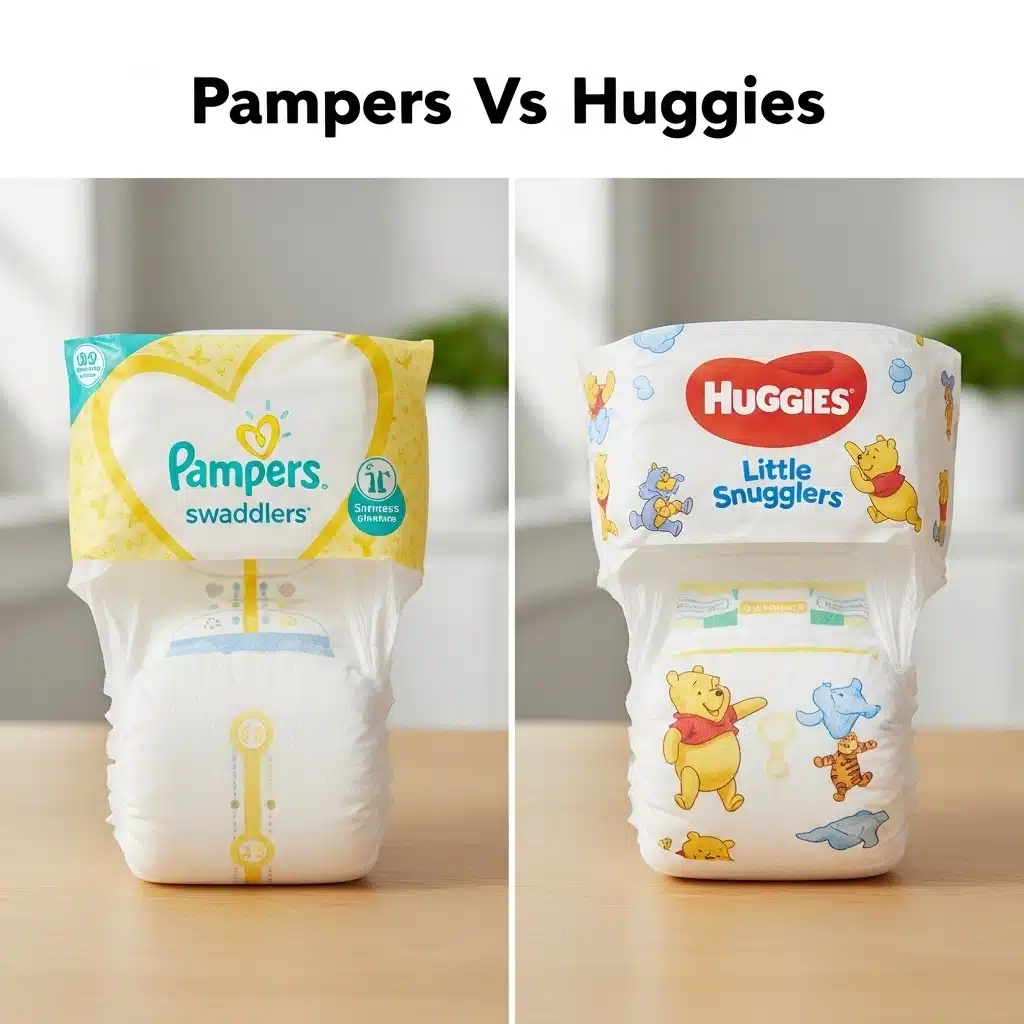
At a Glance
| Feature | Pampers Diapers (Swaddlers Line) | Huggies Diapers (Little Snugglers Line) |
|---|---|---|
| Softness & Comfort | Extremely soft and “irresistibly” plush | Very soft, but firmer than Pampers |
| Wetness Protection | KeepDry liner locks wetness away from skin | Leak Lock System protects up to 12 hrs |
| Blowout Protection | 100% leakproof with guard + barrier + absorbent core | Front & back blowout blocker (sizes 1–2 only), 28% fewer blowouts vs store brands |
| Skin Safety | Hypoallergenic, dermatologist approved, no parabens, chlorine, latex | Hypoallergenic, fragrance-free, no parabens, chlorine, phthalates, latex |
| Overnight Sleep Performance | #1 brand for sleep based on sales | Up to 12 hours leak protection |
| Medical Trust | #1 Pediatrician recommended, trusted by NICU professionals | Hypoallergenic for sensitive skin, fewer blowouts vs leading store brands |
| Fragrance | Light baby-fresh scent in some packs | 100% fragrance-free |
| Fit Style | Slightly snug, stretchy waistband | Roomier fit, especially around thighs |
| Best Size Range Claimed | All sizes | Blowout blocker applies to size 1–2 only |
| Packaging | May vary | May vary |
Softness and Comfort: The “Cuddle Test”
The first thing you notice when you touch Pampers Swaddlers is that they feel like soft cotton clouds. Pampers markets this line as their “softest comfort ever,” and honestly, it’s not far from the truth. The interior liner is cushioned and gentle against baby skin, which is why many parents instinctively reach for Pampers when they care most about newborn coziness.
Huggies Little Snugglers also bring strong softness, but they’re engineered with a slightly more structured core. That means they feel durable and protective but not as pillow-soft as Pampers. Some parents actually prefer this because it gives the diaper a more secure hug around the baby instead of that ultra-fluffy feel.
Verdict: If your baby had a vote, they’d probably pick Pampers for softness, but for parents who like a firmer protective cradle, Huggies wins on structure without sacrificing comfort.
Blowout Protection: The Poop Apocalypse Scenario
Now let’s talk about the moment every parent has nightmares about: the blowout.
Pampers claims:
- Up to 100% leakproof protection
- All-Around LeakGuard + Blowout Barrier + absorbent core
- Trusted by parents and medical professionals
- Most awarded diaper brand historically
Huggies claims:
- Front and back blowout blocker (sizes 1 & 2 only)
- 28% fewer blowouts compared to store brands
- Lock System that protects up to 12 hours
- However, the blowout blocker advantage doesn’t apply above size 2
In real-life testing, Huggies tends to perform slightly better around the back and thighs, especially for chunky-leg babies. The design focuses a lot on containing mess from both ends, which gives it a noticeable edge when the diaper is shock-tested by newborn-level disasters.
Pampers performs excellently for most blowouts too, but because the fit is a little narrower, some parents report occasional issues when the baby is very active or on the higher end of a diaper’s weight range.
Verdict:
✔ Huggies wins for blowout containment on size 1–2
✔ Pampers wins for broader leakproof protection across all sizes
If your baby is already size 3 or higher, Pampers becomes the safer long-term blowout pick simply because Huggies no longer offers the special blocker in those sizes.
Wetness Protection & Skin Contact: The Rash Risk Factor
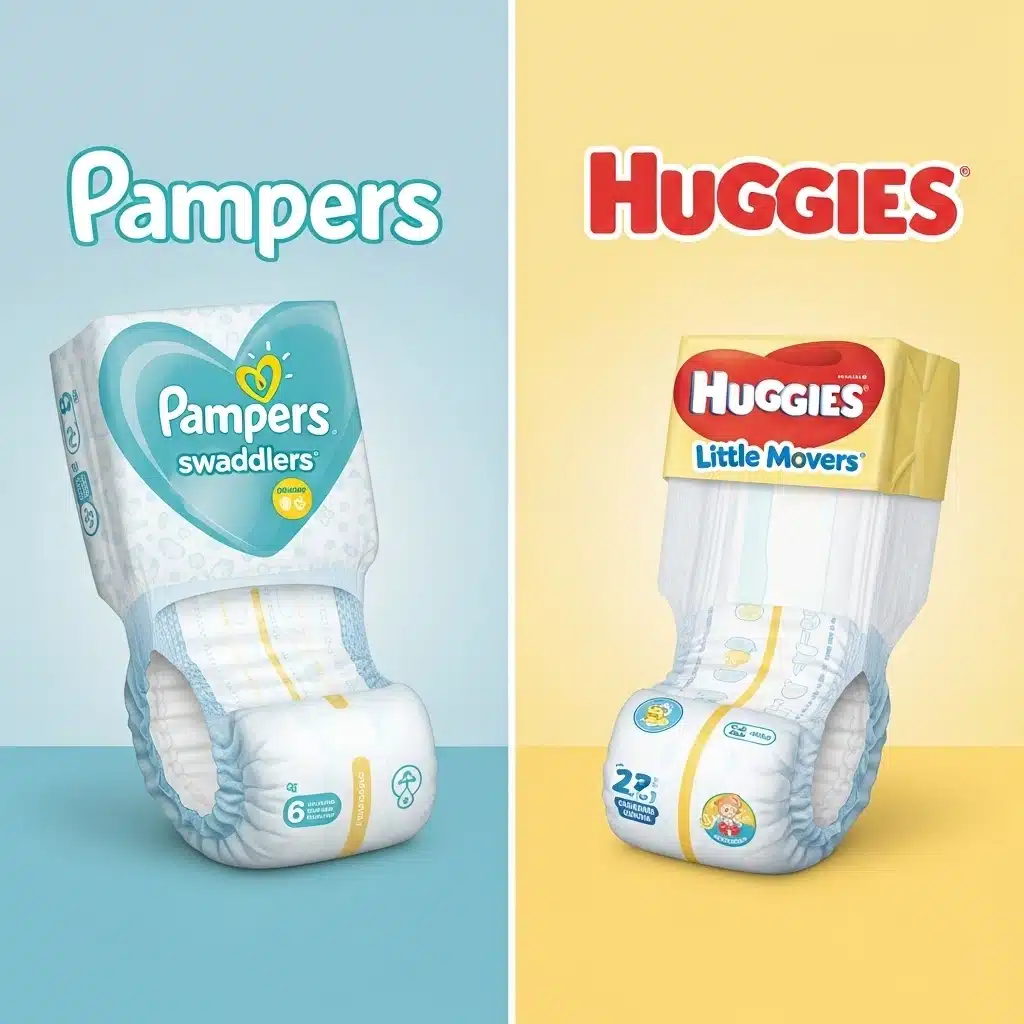
Both brands are hypoallergenic and free from harsh chemicals like parabens, chlorine, and latex. That’s a tie when it comes to basic safety.
But here’s a key difference many parents notice:
- Pampers’ KeepDry liner locks wetness away from the skin, meaning the inner surface stays drier when touched, even when the diaper is full.
- Huggies’ Leak Lock system provides up to 12 hours protection, but the liner can feel slightly damp to touch when heavily used.
For babies prone to diaper rash, that drier inner surface really matters. A diaper that keeps liquid off the skin reduces irritation from prolonged contact, especially during sleep.
Huggies counters this by being fragrance-free, which can be better for extremely sensitive babies who react to scented diapers.
Verdict:
✔ Pampers wins for drier liner performance
✔ Huggies wins for completely fragrance-free skin experience
Overnight Performance: The Sleep-Through-the-Night Challenge
Pampers Swaddlers is statistically popular for sleep, marketed as the #1 sleep diaper choice based on 52-week sales data. This shows that most parents trust Pampers for nighttime dryness.
Huggies still promises up to 12 hours leak prevention, which is strong for overnight use, but many parents point out that Pampers feels drier inside after long wear.
If your baby is a heavy wetter, Pampers handles nighttime full loads more gracefully. If your baby is average but moves a lot in the crib, Huggies’ wider fit may feel more secure at the back.
Verdict:
✔ Pampers wins for heavy overnight wetters
✔ Huggies wins for overnight fit and movement comfort
Fit & Design: The “Will This Close on a Wiggly Baby?” Test
One of the most frustrating parts of diapering is getting a good fit while the baby does gymnastics during changes.
- Pampers has a stretchy waistband and snugger fit
This works great for slim or average-size babies but can feel tight around the thighs for chunkier babies. - Huggies has a roomier, flexible fit around the legs
It works incredibly for babies with thicker thighs and gives more coverage at the back.
Parents who have switched between the two usually say:
“Pampers hugs the tummy better, Huggies hugs the legs better.”
Verdict: It’s not one-size-fits-all:
- Slim babies → Pampers fits best
- Thick-thigh babies → Huggies fits best
Smell & Fragrance: The “Fresh or Free?” Decision
This one comes down to personal preference (and baby tolerance):
- Pampers may include a light baby-powder scent in some packaging
- Huggies is 100% fragrance-free
If avoiding fragrance is a priority for you, or your baby reacts to scents, Huggies pulls ahead instantly here.
Verdict:
✔ Huggies wins for fragrance-free purity
✔ Pampers still gets a pass for non-irritating mild scent
Medical and Professional Trust: Who Do Hospitals Prefer?
- Pampers is the #1 pediatrician-recommended diaper and also the #1 choice of NICU professionals based on recent surveys.
- Huggies is also dermatologically and hypoallergenic approved for sensitive skin, though their messaging focuses more on comparison with store brands rather than hospital dominance.
While Pampers clearly dominates medical professional trust branding, Huggies shines when it comes to reducing blowouts compared to generic competitors.
Verdict:
✔ Pampers wins for hospital and doctor reputation
✔ Huggies wins for consumer vs store-brand performance comparison
Awards, Reliability, and Parent Adoption
Pampers is mentioned in multiple studies as the most awarded diaper brand from 2021–2025, and the #1 choice of parents based on 52-week sales data.
However, awards and sales volume don’t automatically mean perfection for every baby. Sometimes a diaper that wins in stats loses in fit for an individual baby, which is why the debate never ends.
Verdict:
Pampers wins awards + parent adoption metrics
But…
Huggies can still be the winner for specific body types and size range
Final Decision: Who Should Buy Which?
| Baby Type / Need | Best Option |
|---|---|
| Baby easily gets rashes from wetness | Pampers (drier liner) |
| Baby is extremely sensitive to fragrance | Huggies (fragrance-free) |
| Frequent blowouts in size 1–2 | Huggies |
| Heavy overnight wetter | Pampers |
| Slim baby body shape | Pampers |
| Chunky thighs, active baby | Huggies (size 1–2), Pampers (size 3+) |
| Long-term leak protection across all sizes | Pampers |
My Honest Take
If I were building a newborn diaper stack, I’d grab:
- Huggies Size 1–2 for daytime blowout armor
- Pampers Size 1–3+ for overnight dryness and long-term reliability
Not because one brand is bad, but because each has a zone where it performs best.
Leave a Reply